


04 Nov Polyester Powder Coating

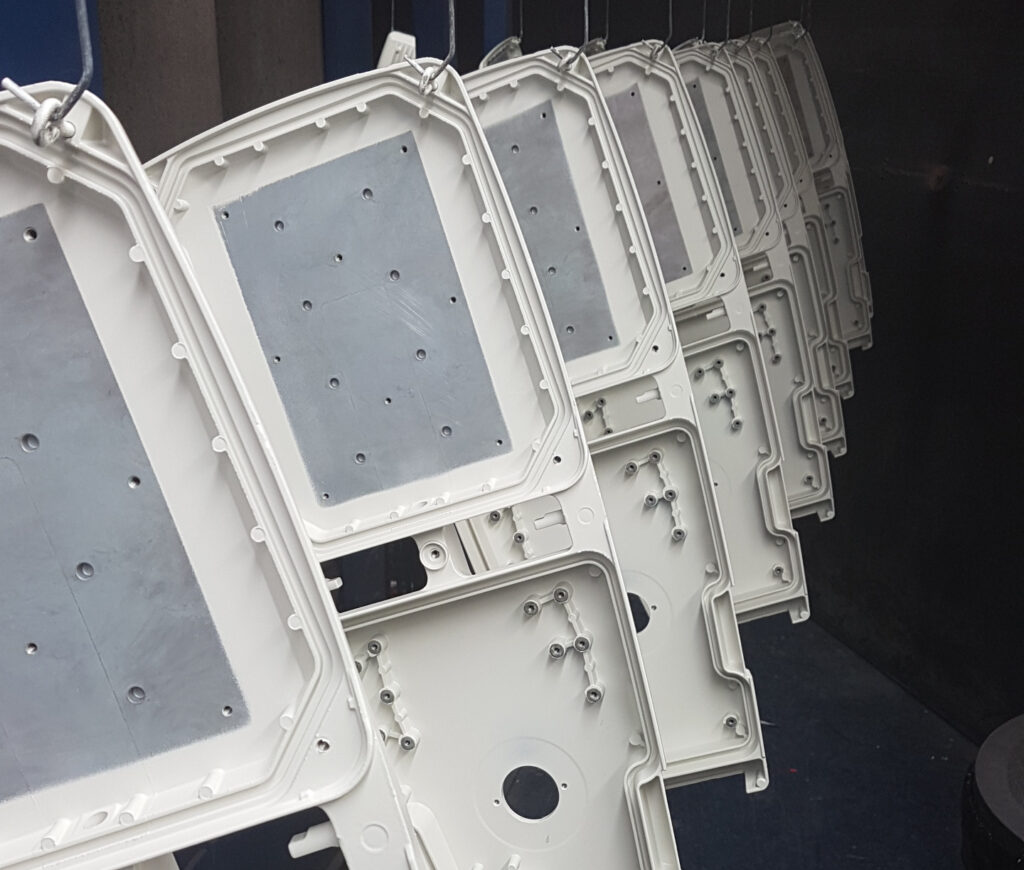
Polyester is the most widely used powder coating in the world and for good reason. It offers an excellent balance of durability, UV resistance, colour retention and cost-effectiveness that makes it the default choice for the majority of general industrial, architectural and commercial finishing applications.
If you’re specifying a powder coating and don’t have a specific reason to choose otherwise, polyester is almost certainly the right starting point.
What Is Polyester Powder Coating?
Polyester powder coating is a thermosetting finish based on polyester resin chemistry. Like all powder coatings, it’s applied electrostatically as a dry powder and cured in an oven at around 160–200°C, where it cross-links into a hard, continuous protective film.
What distinguishes polyester from other powder coating chemistries – primarily epoxy – is its UV stability. Polyester maintains its colour and gloss in direct sunlight far better than epoxy, which chalks and fades when exposed to UV over time. This makes polyester the go-to choice for any application with outdoor exposure.
For a broader overview of how the powder coating process works, see our complete guide to powder coating.
Advantages of Polyester Powder Coating
UV resistance and colour retention: Polyester retains its colour and gloss significantly better than epoxy when exposed to sunlight and weathering, making it an ideal solution for outdoor applications.
Durability: A properly applied polyester powder coat is hard, impact-resistant and resistant to chipping, scratching and abrasion. It outperforms liquid paint in almost all of these areas.
Flexibility: Polyester coatings have good flexibility, meaning they can accommodate minor movement in the substrate without cracking – important for components that experience vibration, thermal cycling or mechanical stress.
Wide finish range: Polyester is available in a broader range of finishes than most other powder chemistries – high gloss, satin, matt, textured, wrinkle, metallic and more. Combined with RAL, Pantone and BS colour matching, it gives considerable aesthetic flexibility.
Cost-effectiveness: Polyester powders are competitively priced and process efficiently. Good transfer efficiency, consistent results and a single-pass application make them cost-effective at both small and large volumes.
Environmental credentials: Powder coating in general produces no solvent emissions and minimal waste through overspray reclamation. Polyester powder coating has a lower environmental footprint than liquid paint alternatives.
TGIC-Free Polyester
Standard polyester powder coatings have historically used TGIC (triglycidyl isocyanurate) as a curing agent. TGIC is effective but classified as a mutagen and reproductive toxin, which has led to increasing regulatory pressure and a shift toward TGIC-free formulations.
TGIC-free polyester uses alternative curing agents, typically HAA (hydroxyalkylamide), that deliver comparable performance without the associated health and regulatory concerns. In most applications the finished coating is virtually indistinguishable from TGIC-based alternatives.
At Frederick Cooper, we use TGIC-free powder as standard across all our lines. It’s the right approach from both a health and safety standpoint and an environmental one, and it’s where the industry as a whole is heading.
Indoor vs Outdoor Applications
Polyester is suitable for both indoor and outdoor applications, which gives it an advantage over epoxy (indoor/underground only) and makes it the most versatile of the standard powder coating chemistries.
Outdoor applications – architectural metalwork, window frames, curtain walling, fencing, street furniture, agricultural and construction equipment, garden structures. Polyester’s UV stability makes it the standard specification for anything with prolonged outdoor exposure.
Indoor applications – general industrial components, furniture frames, shelving, commercial interiors, white goods, electrical enclosures. Polyester is entirely capable here too, though for applications with heavy chemical exposure, an epoxy or epoxy-polyester hybrid may offer better resistance.
Where the end-use environment is aggressive – coastal locations, industrial atmospheres, chemical exposure – the powder specification should be discussed with a finishing specialist. We can advise on the right polyester grade or whether a different chemistry is more appropriate.
Polyester vs Epoxy Powder Coating
The most common comparison is between polyester and epoxy powder coating. Here’s how they differ in practice:
| Polyester | Epoxy | |
| UV stability | Excellent | Poor – chalks and fades outdoors |
| Chemical resistance | Good | Excellent |
| Adhesion | Very good | Excellent |
| Best for | Outdoor and general indoor use | Indoor, underground, chemical environments |
| TGIC-free options | Yes – widely available | Yes |
| Colour retention | Excellent | Fades in UV |
For most applications, polyester is the stronger choice. Epoxy comes into its own where chemical resistance is the primary requirement and outdoor UV exposure isn’t a factor – pipework, underground infrastructure, industrial equipment in chemical environments.
For applications where both UV stability and chemical resistance are needed, an epoxy-polyester hybrid is worth considering.
What Materials Can Be Polyester Powder Coated?
Polyester powder coating works across the full range of conductive metal substrates:
- Aluminium – one of the most common applications. Polyester is widely specified for architectural aluminium due to its UV stability and colour retention.
- Stainless steel – polyester delivers a clean, durable finish on stainless, often used where both corrosion resistance and aesthetics matter.
- Zinc and galvanised steel – polyester over zinc is a common specification for outdoor metalwork requiring both galvanic and coating protection.
- Mild steel – the most common substrate for polyester powder coating in general industrial applications.
Pre-treatment requirements vary by substrate and are critical to a lasting result. See our individual material pages for more detail.
How Long Does Polyester Powder Coating Last?
Properly applied polyester powder coating is highly durable:
- Indoors: 15–20 years
- Outdoors, standard environments: 10–15 years
- Coastal or aggressive environments: dependent on grade and specification
Longevity depends primarily on two factors: pre-treatment quality and correct powder selection for the end-use environment. Selecting a higher-durability polyester grade – super-durable or ultra-durable polyester – significantly extends outdoor lifespan and is worth specifying for architectural or long-term external applications.
Get in Touch
Frederick Cooper has been powder coating metal components in Birmingham since 1879. If you have components that need finishing and want to discuss the right powder specification for your application, get in touch.
Find out more about our powder coating services or read our complete guide to powder coating.
Call us on 0121 772 4201 or email info@frederickcooper.co.uk